
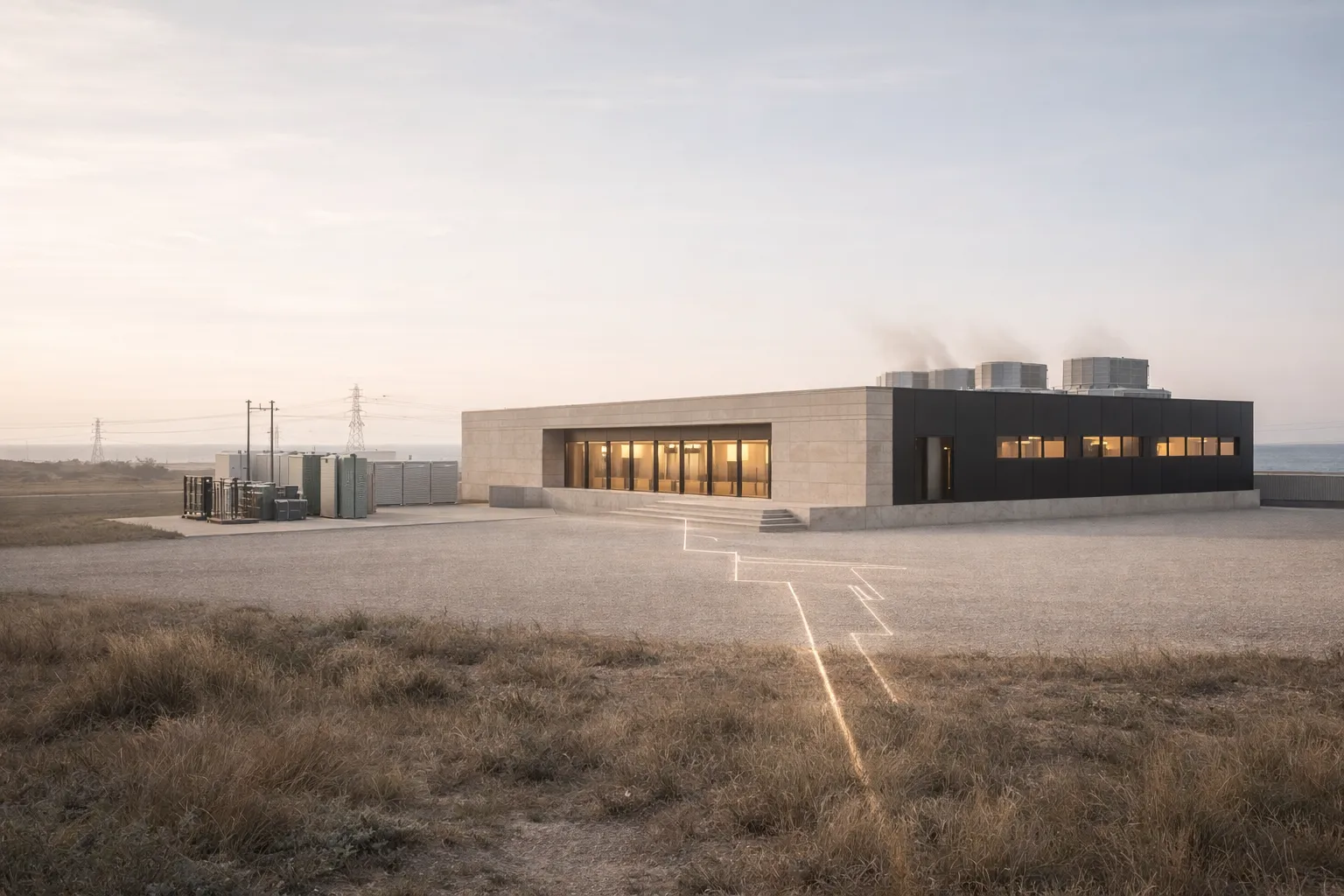
Every AI request uses electricity. But there is no honest universal "energy per token" number. It depends on model size, hardware, utilization, batch size, and cooling overhead. The hardware math is much clearer.
An NVIDIA H100 SXM is rated at up to 700 watts. A DGX H100 system with eight H100s is rated at 10.2 kW max. Thirteen of those systems, roughly 104 H100 GPUs, imply about 133 kW of IT load before cooling or power-conversion overhead. At a fairly efficient power usage effectiveness (PUE) of 1.2, that becomes about 159 kW at the meter, or roughly 114 MWh if run flat out for 30 days. The constraint is not abstract. It is electrical infrastructure.
The AI industry's energy demand is growing faster than grids can expand. That mismatch is already shaping what gets built, where companies can operate, and how credible climate targets look once real load arrives.
The Numbers
The scale of the demand increase is large, but it needs to be stated precisely. In the United States, data centres consumed about 176 TWh in 2023, roughly 4.4% of total US electricity use. The Department of Energy projects that figure rising to 325 to 580 TWh by 2028, or about 6.7% to 12% of US electricity.
Globally, the IEA estimates data centres used about 415 TWh in 2024, around 1.5% of world electricity consumption. Its base case reaches roughly 945 TWh by 2030, just under 3% of global demand. The United States accounted for 45% of global data centre electricity use in 2024, China 25%, and Europe 15%.
The regional growth is uneven. The IEA expects US data centre electricity demand to rise by about 240 TWh from 2024 to 2030, up roughly 130%. China adds another 175 TWh, up 170%. Europe grows by more than 45 TWh, about 70%. Southeast Asia more than doubles over the same period.
AI workloads are the main reason. In the IEA's base case, electricity use in accelerated servers, mainly driven by AI, grows about 30% per year through 2030 and explains almost half of the net increase in global data centre electricity demand.
Grids Weren't Built for This
The problem isn't just that AI needs more electricity. It's that grids in every major market are hitting capacity constraints at the same time.
United States
PJM's 2027/2028 capacity auction is the clearest current warning. PJM says the auction cleared supply plus fixed-resource commitments fell 6,623 MW short of the reliability requirement. It also says the forecast peak load for that delivery year rose by about 5,250 MW versus the prior auction, and nearly 5,100 MW of that increase came from data centre demand.
At the utility level, the load requests are even more startling. AEP Ohio said prospective data centre customers had requested more than 30,000 MW before its new tariff process forced more concrete commitments. By February 2026, only 13,022.7 MW had moved into formal studies, while total contracted data centre projects in its territory reached 17,861 MW. For context, AEP Ohio says its peak demand across all customers has ranged from about 8,000 MW to 10,500 MW.
Europe
Ireland is the cleanest hard-data example in Europe. The Central Statistics Office says data centres used 6,969 GWh in 2024, up 10% year over year, and accounted for 22% of all metered electricity consumption. That share was 5% in 2015. At the same time, the European Commission's AI Continent Action Plan calls for at least tripling EU data centre capacity within the next five to seven years. The policy ambition is clear. The grid constraint is just as clear.
Asia-Pacific
Singapore shows what controlled growth looks like when land, water, and power are all tight. After pausing new data centre growth in 2019, Singapore reopened the market through a more selective process. Its 2024 Green Data Centre Roadmap says the country already has more than 1.4 GW of data centre capacity and aims to add at least 300 MW more in the near term, with further growth tied to green-energy deployment. More broadly, the IEA expects Southeast Asia's data centre electricity demand to more than double by 2030.
The pattern is the same everywhere: demand is arriving faster than supply.
Climate Commitments Under Pressure
The climate math is not simple. Operational efficiency is improving, but the buildout itself still carries a large energy and carbon cost.
Google's 2025 environmental report says it reduced data centre energy emissions by 12% in 2024 and signed contracts for more than 8 GW of clean energy generation in the same year. Microsoft, by contrast, says its aggregate Scope 1-3 emissions for fiscal year 2023 were 29.1% above its 2020 baseline, and explicitly attributes most of that increase to more data centres and the embodied carbon in concrete, steel, semiconductors, servers, and racks.
That is the real tension. AI infrastructure is getting more efficient per unit of compute, but total system demand is still rising fast enough to make climate targets harder to hit.
The firm-power problem
When clean electricity cannot be delivered fast enough, companies look for firm capacity. The Microsoft-Constellation agreement around the restart of Three Mile Island Unit 1, now the Crane Clean Energy Center, is a good example. Constellation says the plant would return 835 MW to the grid in 2028 under a 20-year power purchase agreement with Microsoft, and that the restart requires about $1.6 billion in capital investment. That is not a $1.6 billion Microsoft reactor purchase. It is a long-term offtake agreement backing a utility-led restart because existing clean supply is too scarce.
What This Means for Infrastructure Decisions
Energy is becoming a first-order constraint on AI strategy. Teams making infrastructure decisions need to account for it.
Location is an architectural decision
Where you run compute determines what you can build:
- Ireland still offers low-latency access to European markets, but the power system is already tight enough that data centres took 22% of metered electricity in 2024.
- PJM territory and Ohio remain major US growth zones, but the official auction and utility numbers now show data centre demand arriving faster than new supply.
- Singapore remains strategically valuable in Asia, but capacity growth is explicitly tied to power efficiency and green-energy availability rather than unconstrained expansion.
The cheapest GPU hour means nothing if you can't get the power to run it.
Power costs are diverging
National averages already matter. According to the EIA, the US average industrial electricity price rose from 6.81 cents/kWh in 2019 to 8.62 cents/kWh in 2025, about a 27% increase.
On the 104-H100 example above, that same load profile would cost about $7,800 per month at the 2019 national industrial average and about $9,900 per month at the 2025 average. Regional spreads matter more. At $0.08/kWh, that cluster costs about $9,200 per month in electricity. At $0.18/kWh, it costs about $20,600 per month. That is before rent, networking, staffing, or backup power.
Capacity planning is energy planning
If your AI strategy assumes you can scale compute on demand, check whether the grid agrees. Reserved GPU capacity that can't be powered is expensive dead weight. Teams building in-house clusters need to answer questions that used to be irrelevant:
- Is our regional utility adding generation capacity?
- Are they accepting new heavy loads, or have they paused connections?
- What's the realistic interconnection timeline (months or years)?
- Can we secure a power purchase agreement for price stability?
- What happens to our costs when regional electricity prices rise 40%?
These are now infrastructure questions that directly affect product roadmaps.
The Takeaway
Every token has a watt behind it, but the honest way to talk about that watt is through real infrastructure numbers, not folklore. US data centres used 176 TWh in 2023 and could reach 325 to 580 TWh by 2028. Ireland's data centres already account for 22% of metered electricity use. PJM's latest auction fell 6,623 MW short of its reliability requirement, with almost all forecast load growth coming from data centres. Singapore is growing data centre capacity, but only through a tightly managed power-and-efficiency framework.
This is not a hypothetical constraint. It is already shaping where companies build, what they can scale, and how they finance clean power. Power is the bottleneck, and teams that treat energy as a primary infrastructure constraint will make better decisions than teams that only compare GPU-hour pricing.